Road Signs Test
Introduction
Getting ready for your road signs test?
This article gives a quick, clear overview of what’s on the exam and why it matters.
You’ll learn how shapes, colors, and symbols drive fast recognition for real safety.
We’ll also cover state-specific tips for NC, Georgia, and Missouri.
You’ll get links to official handbooks and practice pages to study smarter.
Expect a simple plan, quick drills, and fixes for look-alike signs.
You’ll learn how to spot tricky pairs like Merge vs Added Lane fast.
We’ll show you shape-first recognition and two quick timed drills.
Use these to build confidence before you open a single practice test.
Finally, we’ll point you to credible sources used by the DMV.
You’ll know exactly what to study and what to skip for test day.
Start now and aim to pass on your very first try.
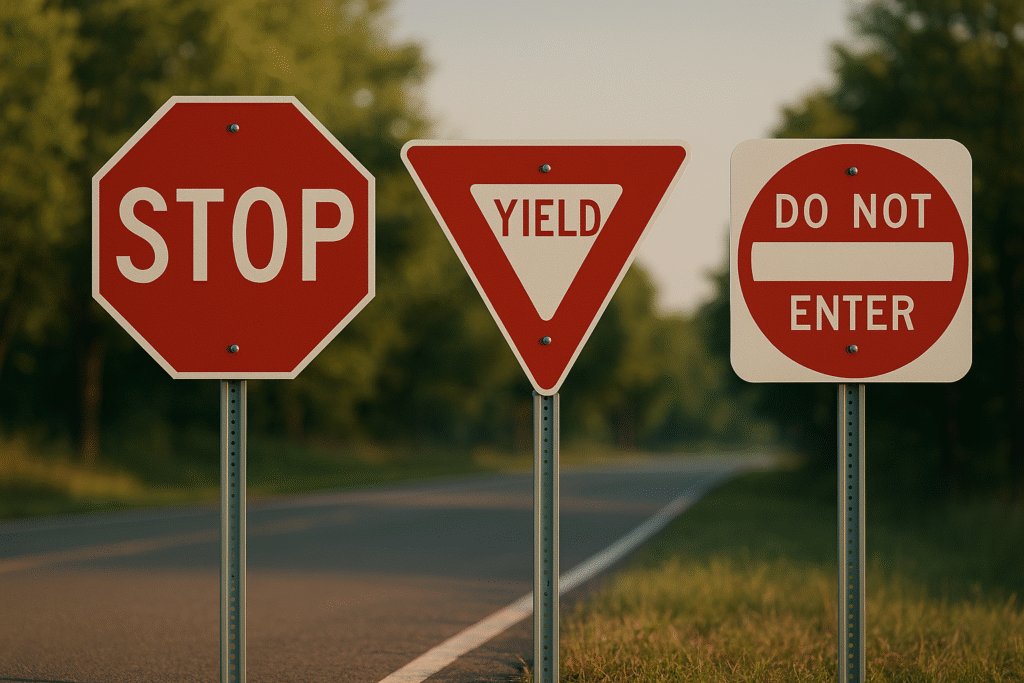
Why the road signs test matters
The road signs test checks if you can recognize shapes, colors, and symbols quickly.
That skill keeps you—and everyone around you—safe.
In this guide, you’ll learn exactly what shows up on a DMV road signs test, how to study smarter, and the specific rules and resources for North Carolina, Georgia, and Missouri. We’ll also share quick drills, image alt-text ideas, and links to official handbooks.
What the DMV road signs test includes
Most states pull road sign content from the Manual on Uniform Traffic Control Devices (MUTCD). Expect questions on:
- Regulatory signs (obey or face penalties)
- Warning signs (hazards ahead)
- Guide signs (routes, services, destinations)
Shapes and colors matter as much as words:
- Octagon = STOP, Triangle = YIELD, Diamond = warnings, Rectangle = regulations/guide, Pentagon = school zone, Round = railroad crossing. These conventions help you recognize signs even when visibility is poor.
Pro tip: Many tests show a sign with no text and ask what it means. Train your brain to answer from shape and color first, then symbols.
Core categories you must master
1) Regulatory signs (must-obey rules)
Speed limits, lane use, turns, parking, and movement restrictions (e.g., No U-Turn, Do Not Enter, Wrong Way, HOV Lane). These are typically red/white or black/white.
2) Warning signs (hazards and conditions)
Animal crossings, merges, lane drops, curves, slippery roads, work zones. Usually yellow/black or orange/black in work zones. Placement distances are engineered for readability and reaction time.
3) Guide and service signs
Highway route shields, distance/direction, rest areas, gas/food/hospital, and recreational points of interest.
State-specific quick guides
North Carolina: NC road signs test
North Carolina’s driver testing includes traffic signs, motor vehicle laws, and a driving skills test. For the signs test, you must identify signs by color and shape and explain what each means. This is spelled out in the official NC Driver Handbook.
What to study for NC:
- Chapter on Signals and Signs (regulatory, warning, guide)
- Shape/color identification drills (STOP, YIELD, school zone, railroad roundel)
- Work-zone signs and speed management
Official resource: North Carolina Driver Handbook (PDF).
Georgia: Road signs test Georgia (DDS)
Georgia’s Knowledge Exam has road rules and road signs testing for first-time applicants (learner’s permits and licenses). The DDS points you to the Driver’s Manual and offers an online practice test.
What to study for GA:
- Sign shapes and colors (Georgia emphasizes knowing both)
- Work-zone and move-over cues, school zones, and lane-use control
- Practice questions from the official DDS page and manual
Official resource: DDS Practice Tests & Guides and DDS Driver’s Manual.
Missouri: Road signs test Missouri (DOR)
Missouri’s driver examination is four parts: written (laws), vision, road sign test, and driving test. You’ll always face the road sign component when getting a new license, and in certain renewals or transfers. The state provides a Driver Guide and a Highway Sign Recognition Study Sheet to focus your prep.
What to study for MO:
- Recognition of common signs (e.g., Added Lane, Slippery When Wet, Intersection, Railroad Crossing)
- Meaning of shapes/colors and symbol-only signs
- Work-zone warnings and speed compliance
Official resources: Missouri Driver Guide (PDF) and Highway Sign Recognition Study Sheet (PDF).
Exactly how to study (and remember) road signs fast
Learn by shape and color first
Your eyes should trigger on octagon, triangle, diamond, round, pentagon, rectangle before you read any words. This mirrors how questions are asked on the exam—and how real drivers react on the road.
Build a “top-25” sign deck
Write or print the 25 signs you see most in your state (STOP, YIELD, No Passing Zone pennant, School Zone pentagon, Merge, Lane Ends, Added Lane, Divided Highway begins/ends, Two-Way Traffic, Deer Crossing, Speed Limit, Advisory Speed Plaque, No Turn on Red, Roundabout, Work Zone, Flaggers Ahead, Detour, Road Closed, RR Crossbuck, Hospital, Rest Area, Gas, Exit Only, HOV, Slippery When Wet). Shuffle and drill until instant.
Use spaced repetition
Study 10 minutes in the morning and 10 at night. Missed cards go back into the deck until you’re 100%. Two days later, review again. You’re training recall speed.
Mix symbol-only and text-only variants
Many MUTCD-compliant signs rely on symbols—train your recognition without reading. Then test yourself with text-only lists (“Which sign is pentagon-shaped?”) to force reverse recall.
Practice with official sources
- NC: Study the handbook’s signs chapter and sample items.
- GA: Take the DDS practice test and read the manual.
- MO: Use the Driver Guide and the Signs Study Sheet to lock in meanings.
The 7 sign families to nail (with examples)
- Right-of-way & control
STOP, YIELD, ALL WAY, Do Not Enter, Wrong Way. - Speed management
Speed Limit, Advisory Speed Plaque, Minimum Speed, School Zone speed. - Passing & lane use
No Passing Zone (yellow pennant), Lane Ends, Added Lane, Center Lane Only (two-way left-turn), HOV lane. - Movement restrictions
No U-Turn, No Left Turn, No Right Turn, Turn Only. - Geometry & surface
Curve/Sharp Turn, Winding Road, Divided Highway begins/ends, Bump/Dip, Slippery When Wet. - Traffic patterns & merges
Merge, Two-Way Traffic, Roundabout Ahead, Signal Ahead. - Railroad, school, and pedestrian
Round railroad advance warning, Crossbuck, School Zone pentagon, Pedestrian Crossing.
(These families align with MUTCD classifications; your state manual uses the same framework.)
Mini-drills you can do today
- Shape sprint: List the 6–7 core shapes. For each, write its meaning from memory.
- Color match: Yellow = hazard ahead. Orange = temporary/work zone. Red = prohibition/stop. Green = guide. Blue = services. Brown = recreation/cultural. White/black = regulations.
- Two-second ID: Flip a sign card and name it in two seconds or less to mimic real-world reaction.
- Work-zone set: Memorize ROAD WORK AHEAD, DETOUR, FLAGGER AHEAD, END ROAD WORK, and the orange speed plaques. Then practice safe speed strategies.
Test-day strategy: how to ace the DMV road signs test
- Answer by shape/color first. It filters choices fast.
- Eliminate by category. If the sign is yellow/diamond, it’s a warning, not a regulation.
- Watch for look-alikes. Added Lane ≠ Merge; Lane Ends needs a merge maneuver, Added Lane doesn’t.
- Slow down on symbol-only items. Confirm the icon (e.g., divided highway “islands” opening vs. closing).
- Don’t overthink. MUTCD designs are consistent across states. Choose the standard meaning.
State sections: requirements and resources (at a glance)
North Carolina (NC DMV road signs test)
- What’s on it: Identify signs by color and shape, explain meanings; part of the NC testing sequence alongside laws and skills.
- Where to study: Official NC Driver Handbook (PDF).
- Pro tip: NC often emphasizes shape/color recognition—practice silent ID before reading.
Georgia (DDS road signs test)
- What’s on it: Road signs are a distinct part of the Knowledge Exam.
- Where to study: DDS Practice Tests & Guides and the DDS Driver’s Manual.
- Pro tip: Drill sign shapes and school/bus/railroad priorities common in GA training materials.
Missouri (DOR road signs test)
- What’s on it: Missouri’s driver exam is four parts and always includes a road sign test.
- Where to study: Missouri Driver Guide and the Highway Sign Recognition Study Sheet (excellent for last-minute cramming).
- Pro tip: MO materials show classic symbol-only warnings—practice with no text hints.
Sample Q&A you might see
Q: What does a round yellow sign with a black “X” and two “R” letters mean?
A: Railroad crossing ahead—slow, look, and listen.
Q: You see a yellow diamond with “Lane Ends.” What should you do?
A: Merge into the adjacent lane safely; signal early and check mirrors/blind spots.
Q: A white rectangular sign reads “Keep Right except to pass.” What is it?
A: A regulatory sign; you must obey it.
(These reflect MUTCD standards used by state exams.)
FAQ (3)
1) Is the road signs test the same in every state?
Not identical, but very similar because states follow the MUTCD baseline for sign standards. Your state manual shows the exact items you’ll see.
2) Where should I start if I have only two days?
Download your state handbook, drill shapes/colors, then practice high-frequency signs and work-zones. Use your state’s official pages first.
3) Do I need to memorize distances or just meanings?
Focus on meanings and actions. Distances are more relevant to safe placement and engineering guidance, but you should know when to slow, yield, stop, or merge.
Conclusion
The road signs test is about fast recognition, not trick questions.
Learn shapes and colors, drill the top 25 signs, and use official state materials.
Do this and you’ll walk in confident—whether it’s NC, Georgia, or Missouri.
Start by opening your state’s official handbook and practice page.
Read the signs section and skim any state-specific notes.
Set a simple plan you can repeat over a few short sessions.
Take two timed practice sets and track your misses carefully.
Notice patterns in your errors and why they happen.
Use shape and color cues to speed up recognition next time.
Review the weak sign families and then retest the same day.
Aim to score 90% or higher twice in a row before test day.
Tell us your experience in the comments—what tripped you up, and what finally made it click?
About the Author